
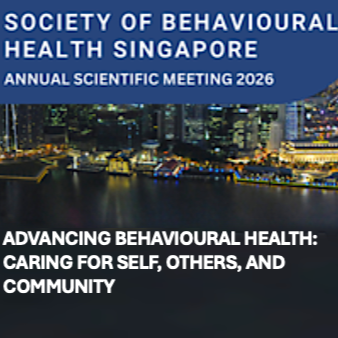
Opening Remarks by SBHS President Ms Susan Tan at the 2026 Society of Behavioural Health, Singapore Annual Scientific Meeting on 30 Jan 2026
Good morning, distinguished guests, partners, colleagues, and friends.
It is my honour to welcome you to the 2026 Society of Behavioural Health Singapore Annual Scientific Meeting. Thank you for taking the time to be with us, and for your continued commitment to advancing behavioural health, preventive care, and population health.
This year’s theme, “Advancing Behavioural Health: Caring for Self, Others, and Community,” reflects both a timely challenge and a shared responsibility. As healthcare systems evolve, we increasingly recognise that health is not shaped by clinical care alone. It is shaped by behaviours, relationships, environments, and the systems that surround people.
At its heart, behavioural health forces us to confront a very practical question:
What has to be true in a person’s everyday life for a healthy behaviour to feel doable — even normal — rather than effortful or unrealistic?
This is why behavioural health — the science, practice, and governance that support it — matters so deeply.
We know that the effectiveness of behavioural interventions varies across populations and contexts. And yet, we often continue to search for an “average” or “best” intervention, as though one solution should work everywhere.
Perhaps it is time to reframe the question.
We might move from asking which intervention is “best,” to:
Under the conditions that I am operating under, which intervention is most likely to work?
No intervention is designed for everyone, everywhere, at all times. It’s always context, context, context. Promising interventions can fail when moved from pilot settings into real-world systems — not because they were wrong, but because the surrounding conditions changed.
This places responsibility on both sides of the evidence–practice relationship.
Those who generate evidence need to be clearer about where and why their findings apply — and where they may not. Practitioners, like myself, in turn, need to remind ourselves that evidence is to be interpreted and adapted, not just wholesale adopted. When context is missing, even the most thoughtful professionals are left guessing.
I hope that as we advance behavioural health, we will move from “behavioural insights” — to it increasingly becoming part of mainstream policy design, service delivery, and system improvement.
We will continue to see increasing adoption of digital health and artificial intelligence in 2026. With AI becoming more embedded in how we do our work, responsible use will be essential. Last year, I worked with an AI startup to develop an AI health coaching agent to increase the accessibility of health coaching service. And I realised that the risks are real: technical failures, profound ethical and safety concerns like Harmful Advice and Hallucinations that can lead to, or exacerbate, harmful physical or mental health outcomes.
I therefore see AI is most valuable as an assistant, not to replace humans. It can help us synthesise, prototype, translate, and test ideas more quickly — but meaning, ethics, and judgement must remain human responsibilities.
These themes — integration of behavioural science, digital health, AI, compassion, addiction treatment, and health coaching within primary care — are reflected strongly in this year’s programme.
Today’s meeting brings together an exceptional group of speakers and moderators across healthcare, public health, academia, community organisations, and policy.
We are honoured to have Associate Professor Raymond Chua, CEO of the Health Sciences Authority, as our Guest of Honour. We thank him for anchoring our special session on vaping — a complex and evolving public health challenge that demands coordinated, evidence-informed responses as a society.
We are also grateful for the strong support of our partners, including the Health Promotion Board and the NUS Saw Swee Hock School of Public Health, whose collaboration reflects the shared leadership required to advance prevention and population health meaningfully.
I would also like to acknowledge our industry partners. We thank our Gold Sponsors — GSK, Gilead, and Kenvue — and our Bronze Sponsor, AstraZeneca, for their support of this annual scientific meeting.
Industry support plays a meaningful role in enabling professional education, scientific exchange, and cross-sector dialogue, especially in areas such as behavioural health and prevention that cut across traditional boundaries of care. Importantly, this support allows SBHS to convene multidisciplinary conversations like this while maintaining our independence, scientific integrity, and commitment to the public interest.
For SBHS, this Annual Scientific Meeting is more than a conference. It is a space for critical reflection, thoughtful dialogue, and collective learning. It is part of a broader journey to strengthen professional standards, build workforce capability, and support the safe and effective integration of behavioural and lifestyle approaches into healthcare and community settings.
We are particularly proud of the progress made in 2025 by our Health Coaching Chapter, which has taken deliberate steps to advance competency, professionalisation, and system integration — through strategic alliances, like the memorandum of understanding that we had just signed with the Healthcare Services Employees’ Union on Wednesday, and our collaboration with NTU Lee Kong Chian School of Medicine to align and build health coaching capabilities for the CADENCE study, a national cardiovascular research initiative integrating basic, translational, and clinical capabilities from hospitals, universities, and research institutions focused on prevention, early detection, and long-term management of cardiovascular diseases. Professor Andy Ho is one of the joint lead. You will hear more from him later. These efforts by the Health Coaching Chapter are further strengthened by strategic alliances that have enabled the roundtable this Saturday afternoon, bringing stakeholders together to share evidence, identify enablers, and shape practice standards.
We are also especially proud to announce that the International Congress of Behavioural Medicine 2027 will be hosted in Singapore. We look forward to welcoming many of you back in 2027, and we invite you to stay tuned to the SBHS website for updates on the scientific programme and workshops, and to join us as collaborators as we prepare to host our international delegates.
Behavioural health work asks more of us than the application of science alone. It asks us to cultivate empathy, communication, cultural awareness, and collaboration. It challenges us to move beyond instruction toward engagement — supporting autonomy, self-efficacy, and resilience, while recognising that behaviour change is rarely straightforward.
As you participate in discussions and workshops over the next two days, I encourage you to engage openly, ask difficult questions, challenge assumptions, and connect across disciplines.
Many of the challenges we face — from chronic disease and vaping to vaccine uptake and mental wellbeing — do not sit neatly within one sector or profession. They require behavioural objectives embedded within sector strategies, institutional capacity-building rather than one-off training, and delivery mechanisms — workflows, environment, service design — that make healthier behaviours easier to sustain.
Co-creation will become less a “nice-to-have” and more a necessity — especially in environments shaped by fatigue, mistrust, and misinformation. Behavioural science must increasingly function as a practical partner to programme design, quality improvement, and implementation.
With this, I would like to thank the organising committee, Dr Clive Tan and Ms Anne Neo, scientific programme lead Dr Rayner Tan, moderators, speakers, and volunteers who have worked tirelessly to make this meeting possible.
It is my privilege to declare the SBHS Annual Scientific Meeting 2026 officially open.
Thank you.